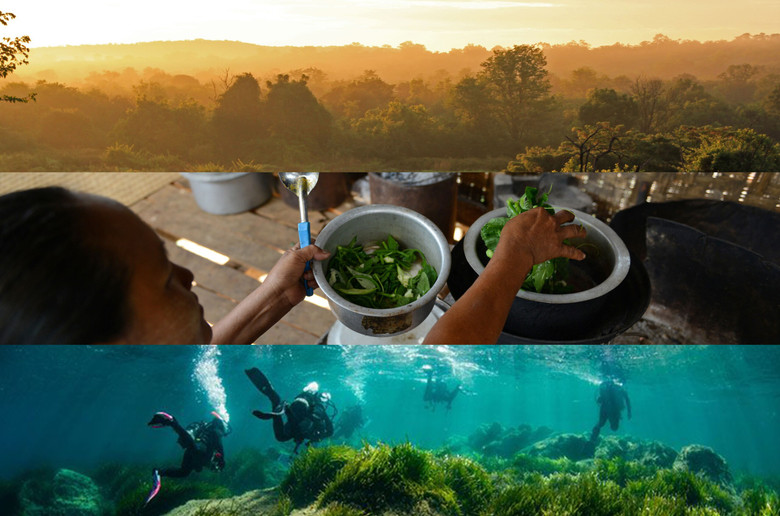
You have recently taken part in the Festival, so find out here about the projects that have been supported thanks to your environmental contributions and with the Festival’s support.
► Over 4.1 million Euros raised for the environment
AGRICULTURAL TRANSITION
Agricultural transition, including carbon reduction in the sector and improved management of natural resources and living heritage, is a major driver in combating global warming.
Both in France and overseas, by supporting agricultural transition projects, better pay and living conditions are guaranteed for farmers, leading to significant shared economic and social benefits for local communities.
Agroforestry and afforestation in India
Location: India
By: Anthesis Group
Year: Festival 2025
The Festival funds this project for a total of €135,000 excluding taxes
The project aims to promote agroforestry – combining agriculture and planting trees on a same site – instead of single-crop farming, which is harmful for the environment, while avoiding the use of fertilizers and pesticides. By using environmentally well-adapted and high-yield eucalyptus varieties and poplar species, the project improves soil fertility, biodiversity, and the economic conditions of farmers.
Soufflet Agriculture: conservation agriculture and methanization
Location: France, Grand Est (Eastern Region)
By: Carbone&Co
Year: Festival 2024
The Festival funds this project for a total of €155,200 excluding taxes
The Soufflet Agriculture project, located in the French Grand Est (Great Eastern) region, involves several farmers converting to conservation agriculture, thereby reducing fuel consumption, increasing ground vegetation cover, and diversifying crops. In addition, by creating a methanization unit, this will make it possible to recycle organic matter and produce biogas.
Planting of orchards by farmers in the Occitan region of France
Location: South of France
By:Carbon&Co
Year: Festival 2023
The Festival funds this project for a total of €231,770 excluding taxes
Five farmers in the Occitan region are planting low-carbon orchards, which are contributing to relocating the apple, pear, and almond-growing industries and storing 3,311 tons of carbon, while having a positive impact on biodiversity, soil health, and water and air quality.
Supporting the agroecological transition of livestock farming and promoting the bocage (a mosaic of cultivated fields and meadows enclosed by a network of hedges) of the Loire
Location: France
By: Solenat
Year: Festival 2022
The Festival funds this project for a total of €90,000 excluding taxes
Located in the Pays de la Loire region, the Carbocage and livestock farming project helps protect the ‘bocage’ landscape and supports low-carbon livestock farming. Farmers receiving support from this project are implementing programs to improve hedgerows via planting and enhanced management aimed at sequestering carbon and improving biodiversity.
The Festival wholly finances this project for a total of €114,540 excluding taxes
Carbocage – Eco-Methane aims to support the adoption of low-carbon livestock farming models and environmentally beneficial agricultural practices in France by changing the diet of their herds of cattle and by planting hedges on their farmland.
These farming practices improve animal welfare, protect biodiversity, enrich the soil, and rebalance the water cycle. They also help prevent carbon emissions and sequester carbon.
Location: Grasse (Alpes Maritimes, France), Domvast and Canchy (Somme, France), Ger (Manche, France) and Serain (Aisne, France), Sauvigny-les-bois (Nièvre, France), Saint-Saury (Cantal, France)
By: Centre National de la Propriété Forestière (French National Forestry Center)
Year: Festival 2021, Festival 2022, Festival 2024
The Festival funds various reforestation projects for a total of €330,022 excluding taxes.
Reforestation after a fire in the Grasse backcountry (Alpes-Maritimes), which destroyed 53 hectares of forest in 2017.
Planting of forests on several plots of grassland, former agricultural land, or fallow land, covering a total of 22 hectares in several departments in northern France (Manche, Aisne, Somme);
Planting of forests on former farmland that has fallen into disuse in Sauvigny-les-Bois (Nièvre);
Planting of forests on farmland in Saint-Saury (Cantal).
BIODIVERSITY
Biodiversity encompasses all natural environments and life forms (plants, animals, fungi, bacteria, etc.), as well as all the relationships and interactions between living organisms themselves and between these organisms and their environments.
Land use by humans and global warming are having a major impact on biodiversity, so much so that scientists are speaking of a “sixth mass extinction.” Supporting projects that preserve natural ecosystems and the biodiversity they contain helps to maintain natural carbon sinks that absorb emissions.
A number of reforestation projects
Locations: Grasse (Alpes Maritimes, France), Domvast and Canchy (Somme, France), Ger (Manche, France) and Serain (Aisne, France), Sauvigny-les-bois (Nièvre, France), Saint-Saury (Cantal, France)
By: Centre National de la Propriété Forestière (French National Forestry Center)
Years: Festival 2021, Festival 2022, Festival 2024
The Festival funds various reforestation projects for a total of €330,022 excluding taxes.
Reforestation after a fire in the Grasse backcountry (Alpes-Maritimes), which destroyed 53 hectares of forest in 2017.
Planting of forests on several plots of grassland, former agricultural land, or fallow land, covering a total of 22 hectares in several departments in northern France (Manche, Aisne, Somme);
Planting of forests on former farmland that has fallen into disuse in Sauvigny-les-Bois (Nièvre);
Planting of forests on farmland in Saint-Saury (Cantal).
Sindh, restoring and preserving mangroves
Location: Pakistan
By: Removall
Year: Festival 2024
The Festival funds this project for a total of €262,048 excluding taxes
The Sindh project concerns the recovery and conservation of mangroves over 350,000 hectares in the Indus Delta region of Pakistan (Thatta and Sujawal districts). Mangroves are particularly effective at sequestering carbon due to their ability to accumulate large amounts of carbon in their roots and the surrounding soil, so helping to combat climate change. By restoring mangrove ecosystems, which act as natural barriers against coastal erosion and storms, the project contributes to the region’s general climate resilience, as well as protecting the biodiversity of mangroves, which act as habitats for many different plant and animal species.
Kariba: forest protection, preservation of flora and fauna
Location: Zimbabwe
By: South Pole
Year: Festival 2022
The Festival funds this project for a total of €380,695 excluding taxes
The project protects nearly 785,000 hectares of forest and numerous wildlife species on the shores of Lake Kariba and along the border between Zimbabwe and Zambia. It incorporates four national parks and eight safari reserves, so forming a wildlife corridor for many vulnerable and endangered species—including the African elephant, lion, hippopotamus, and the southern ground hornbill.
The project is also supporting the development of community gardens, promoting access to healthcare, and offering training in beekeeping in order to foster the self-sufficiency of local communities.
Rimba Raya Biodiversity Reserve
Location: Indonesia Year: Festival 2021
The Festival funds this project for a total of €64,312 excluding taxes
The Rimba Raya Biodiversity Reserve protects over 90,000 hectares of peat swamp forests in Indonesia, which were once threatened with conversion to palm oil plantations. The reserve safeguards biodiversity and the habitat of endangered species such as the Bornean orangutan, while also averting deforestation. As well as sequestering carbon, the project has created jobs for 73 people and supports environmental education and economic empowerment initiatives, particularly for women, with projects involving poultry farming and recyclable crafts.
The Festival funds this project for a total of €84,500 excluding taxes
Due to their status as a “indigenous peoples,” the peoples of the Para region do not possess land titles. The Ribeirihnos Redd project provides certificates of ownership for land that is already held by these peoples in order to protect the forest from illegal deforestation and poaching.
The Festival wholly finances this project for a total of €149,586 excluding taxes
This native Mediterranean forest, located in the hills above the town of Grasse, is currently affected by the decline of century-old Scots pines and the severe drought affecting downy oaks across an area of 75 hectares. The project has three objectives: to help this forest regenerate, to prepare it for climate change, and to preserve the old trees that provide habitats.
WASTE MANAGEMENT
Open landfills, which exist all over the world, accelerate global warming by releasing methane caused by decomposing waste, a gas with a warming effect on the atmosphere nearly 30 times greater than that of carbon.
Capturing methane from landfills and improving waste management not only limits global warming but also improves air quality and the quality of life for people who live near landfills.
Waste recovery in Cameroon
Location: Cameroon
by: Goodplanet Foundation
Year: Festival 2025
The Festival funds this project for a total of €224,000 excluding taxes
The accumulation of waste in dumps in Dschang in Cameroon is harmful for both its inhabitants and the environment, particularly due to emissions caused by methane, a powerful greenhouse gas. By transforming this waste into compost, which will subsequently be used to fertilize soil and support local agriculture, the project reduces emissions, limits dependence on chemical fertilizers by offering a natural alternative, and creates jobs for the local population.
A joint report by the World Health Organization (WHO) and UNICEF states that 2.1 billion people, or 30% of the world’s population, are still without access to safe drinking water in their homes, and 4.4 billion, or 60% of the world’s population, are without safe sanitation services. As well as the harmful health effects of not having access to clean water, people often have to sanitize it by boiling it on wood-burning stoves, which aggravates deforestation. So projects aiming to provide access to clean water also help to preserve natural resources and improve living conditions for the people affected.
Repairing and maintaining wells in Malawi
Location: Malawi
By: ClimatePartner
Year: Festival 2025
The Festival funds this project for a total of €242,800 excluding taxes
The aim of this project is to repair, maintain, and replace defective wells in Malawi, enabling local communities to access safe drinking water without having to boil it in order to make it safe to consume. These wells improve household health, reduce deforestation, and reduce the time spent collecting wood.
Agua do Moçambique
Location: Mozambique
By: Removall
Year: Festival 2023
The Festival funds this project for a total of €293,410 excluding taxes
The project provides clean water by rehabilitating wells and repairing broken drinking water pumps, thereby reducing household wood consumption for purifying water and hence reducing carbon dioxide emissions caused by combustion.
In many parts of the world, cooking is still done using traditional methods. These methods rely on burning wood or organic waste, which is not very energy efficient and has harmful effects on health within the home.
There are several benefits in supporting projects to improve cooking methods: improved health, particularly respiratory, reduced deforestation, and empowerment of women by reducing the time spent on domestic tasks.
Distribution of cooking stoves
Location: Myanmar, Togo
By: ClimateSeed
Year: Festival 2022, Festival 2025
The Festival funds two projects for a total of €439,420 excluding taxes
Myanmar is the world’s third biggest contributor to deforestation. Furthermore, rural families in Myanmar spend up to 40% of their income—or the equivalent in time—on purchasing or collecting firewood. By distributing 30,000 cooking stoves, this project is helping to reduce household wood consumption (and therefore expenditure). This in turn reduces pressure on forests and air pollution, and improves the overall health of local communities.
In Togo, the project is about replacing wood and charcoal with liquefied petroleum gas. This changeover reduces deforestation, improves family health, and reduces the time women spend in the kitchen by providing quick lighting, shorter cooking time, and easier access to fuel supply. The project supports the local economy by creating jobs and forges a lasting impact by bringing families together and maintaining equipment.
The Festival funds this project for a total of €276,000 excluding taxes
This project was developed in Rwanda, and aims to improve traditional cooking methods, which consume a lot of energy and are damaging to health, by offering significant advances in terms of both health and the environment.
By handing out 25,000 cooking stoves, the project enables every family to save a total of around $1,600. The project prevents greenhouse gas emissions by significantly reducing the need for biomass to provide fuel for cooking, so limiting the deforestation of local wooded areas and preserving biodiversity and the well-being of many animal species, including colobus monkeys, gray crowned cranes, and chimpanzees. It meets seven of the United Nations Sustainable Development Goals.
The Festival funds this project for a total of €255,000 excluding taxes
In Mali, 80% of the population uses wood as its energy source, especially for cooking, using traditional equipment that is relatively inefficient. Improved stoves reduce wood consumption, deforestation, and CO2 emissions.
The oceans, and the biodiversity within them, are essential in fighting climate change because they absorb carbon dioxide from the atmosphere and help regulate the climate. However, they are also affected by these changes: rising sea levels, loss of biodiversity, marine heatwaves, acidification, etc. Projects that reduce these impacts make a major contribution to the fight against climate change.
L’Arche de Noé des profondeurs, (Noah’s Ark of the Deep): A future for biodiversity
Location: Mediterranean Basin
By:Fondation 1 OCEAN
Year: Festival 2023
The Festival funds this project for a total of €50,000 excluding taxes
The One OCEAN Foundation aims to explore, document, and share knowledge about the ocean with as many people as possible. The project it supports documents the Mediterranean’s sea fan “forests,” which have been severely affected by ocean warming, and seeks to understand how sea fans and their ecosystem could survive in the deep sea.
PRIME: restoring the Mediterranean coastline
Location: Cannes
By: Fonds de Dotation Cannes (en partenariat avec NaturDive et Blue Leaf Conservation)
Year: Festival 2022
The Festival funds this project for a total of €50,000 excluding taxes
As an endemic Mediterranean species, Posidonia is a very important carbon sink. The Festival’s support for the PRIME initiative will help fund the restoration of damaged Posidonia in the Bay of Cannes.
Alongside the environmental contribution made by festival-goers (€20 per person, excluding tax), the Festival de Cannes also supports associations developing locally based environmental projects in Cannes and the South of France.
Domaine de la Bétheline
Location: Marseille
By: Culture Eco
Year: Festival 2025
The Festival funds this project for a total of €19,000 excluding taxes
At the Domaine de la Bétheline, an innovative farm to the northeast of Marseille, the project aims to plant 45 local varieties of trees in hedgerows, and to raise awareness among young adults of socio-ecological resilience and the fight against climate change. The farm, which spans about 26 soccer fields, practices organic farming, agroforestry, and organizes programs for young adults and disabled people.
L’école au potager (School Vegetable Gardens)
Location: Cannes, Alpes-Maritimes
By: Méditerranée 2000
Year: Festival 2024, Festival 2025
The Festival funds this project for a total of €68,200 excluding taxes over two years.
The École au potager (School vegetable garden) project offers individualized support to schools in the Alpes-Maritimes region throughout the year, focusing on four areas: assistance with setting up and maintaining school vegetable gardens, training workshops to build teachers’ skills on various aspects of vegetable gardening and sustainable food production, raising awareness among children in the classroom on topics chosen with teachers, and creating a collaborative digital tool to encourage project leaders to collaborate and promote their initiatives.
Fighting energy poverty in Marseille’s inner-city neighborhoods
Location: Marseille
By: GERES
Year: Festival 2022, Festival 2025
The Festival funds two projects for a total of €101,948 excluding taxes.
3.5 million low-income households in France are living in energy poverty, facing very high energy bills.
The Festival’s first initiative is in the Cabucelle-Saint-Louis neighborhood of Marseille. Home visits are offered to provide personalized assistance, which can lead to essential work being carried out (e.g., installing double glazing, sealing joints, etc.) by Impulse Toit, a local association that helps people get back into work.
In 2025, support will be focused on integrating solutions that are adapted to the local climate such as installing fans or adding vegetation to optimize comfort, improve health, reduce bills, and contribute to the well-being of people in [energy] poverty.
The Festival funds this project for a total of €50,000 excluding taxes
The Forêt d’Ambrosia project is supported by the Terres de Liens association, with the aim of creating a regenerative, productive, and resilient agrarian system. Forêt d’Ambrosia is an agroforestry farm that will produce organic fruits, berries, and grapes. It will focus on four areas: promoting available biodiversity, creating a resilient crop system, regulating water shortages and surpluses, and raising public awareness.
Réensauvageons le Vercors (Let’s Rewild the Vercors)
Location: Vercors
By:ASPAS
Year: Festival 2023
The Festival funds this project for a total of €50,000 excluding taxes
Biodiversity is facing an unprecedented crisis, so there is an urgent need to preserve areas of unspoiled nature where wildlife can thrive, safe from destruction and human exploitation. The project is seeking to create a huge area of untamed wilderness in the Vercors, a mountain range that serves as a gateway to the Southern French Alps.